
Housing in Numbers: Record after record. How did we get here?
Published 31/Aug/2026 By Ross McGann
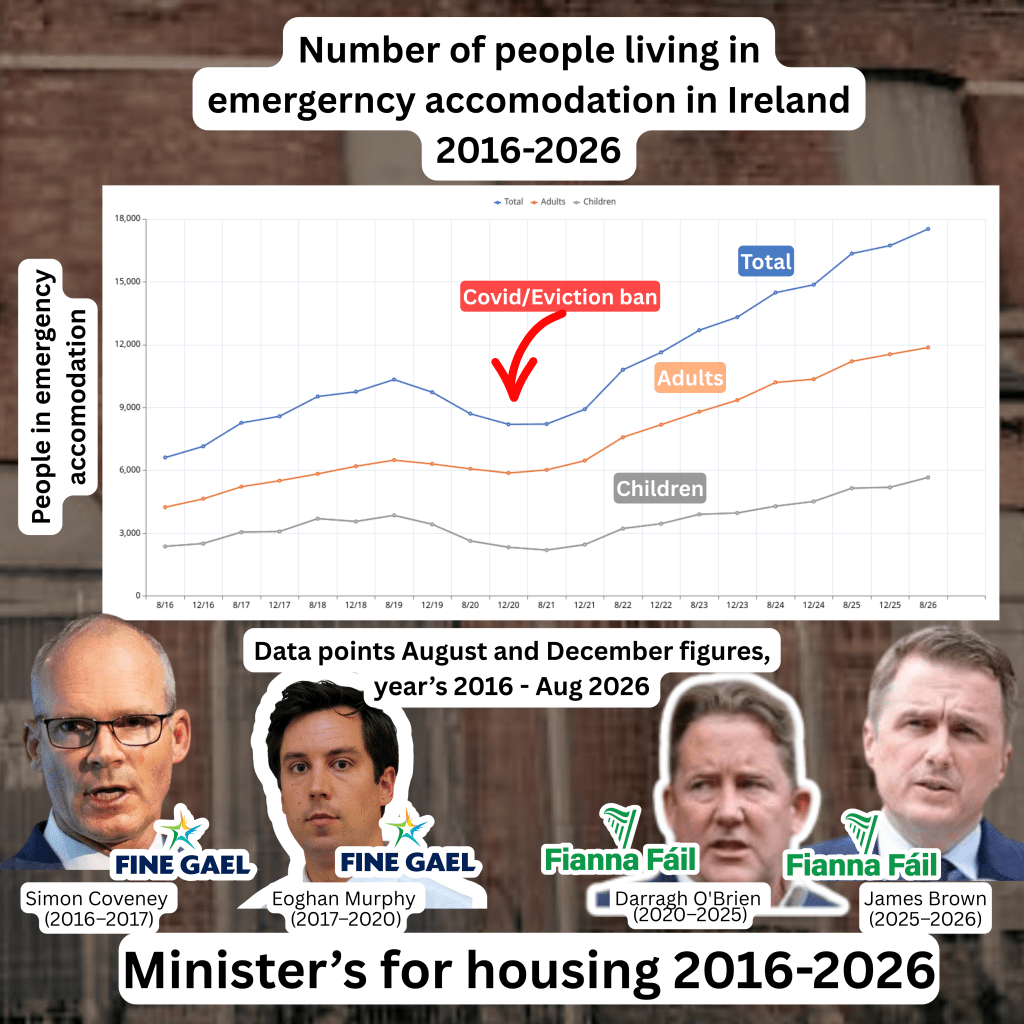
This week, the department of housing released the August 2026 report, detailing July figures relating to the amount of people currently living in emergency accommodation here in Ireland.
17,527 people, 11,868 of whom are adults and 5,659 children availed of emergency accommodation within the country for the month of July. While only a small increase on the previous months figures, it is an increase non the less. The following report takes a look at the housing ministers from the last ten years and some of the policies that they implemented that may tell us the story as to how we got here.
2016 – 2017 Simon Coveney – Fine Gael
“Rebuilding Ireland” Framework – Relied heavily on private sector to build housing supply, start of the “build to rent” model that favorites landlords and developers over people and families.
Honorable mentions: His u-turn on progressive local authority long term homeless housing allocation & Strategic Housing Developments (SHD’s) which is said to have laid the groundwork for bypassing local authorities on planning, stripping communities of their democratic right to input.
2017 – 2020 Eoghan Murphy – Fine Gael
Co-Living and apartment sizes – Reduced the mandatory apartment sizes that can be built and changed design requirements. Also encouraged “Co-Living” developments which some compared to the “Bedsits” of the 70’s and 80’s
Honorable mentions: Tax breaks that invited in “Vulture funds” and institutional “Build to rent” investors & Fast track SHD’s leading to a string of judicial reviews that clogged up the legal system and chocked off supply.
2020 – 2025 Darragh O’Brien – Fianna Fail
Record homeless numbers – Quoted in 2022 as saying “there is no housing crisis”, Lifted eviction ban in April 2023 leading to mass evictions. Steady climb in number of people in emergency accommodation under his tenure.
“Targets” never met – Set government targets for delivery of social and affordable housing, relied mainly on private developers for delivery and consistently under delivered by large differences.
Honorable mentions: First home scheme backfired leading to increased house prices & mishandling of the defective blocks scandal.
2025 – Present/2026 James Browne – Fianna Fail“
“Targets” no more and failed evictions laws – stated that fixed annual housing targets were no longer necessary, while the number of people accessing emergency accommodation continues to rise. Introduced new rental laws in March 2026 which gave leniency to corporate landlords and lead to an sharp rise in evictions.
Honorable mentions: Re-introduced plans to cut the requirements for apartment sizes & MORE tax incentives for corporate developers, putting corporate profit ahead of livable communities.
Conclusion:
Over the last ten years ministers representing the two government parties of Fianna Fail and Fine Gael have provided multiple tax breaks for corporate landlords and developers, they reduced the requirements for apartment size and standard of living. Over the decade the numbers of people in emergency accommodation has continued to rise at a steady rate, dipping only during the eviction ban that began during covid, within three years of the lifting of the ban the number is back on track to create a steady linear increase beginning in 2016. The government parties rely heavily on the private sector to try and deliver social housing, this has lead to an increase in HAP payments to corporate landlords and which costs the public a lot more than providing a state built social home.
Calls from opposition parties for the government to create a public construction company that would focus on critical infrastructure including housing are consistently rejected by government parties as they insist on relying on private developers to deliver public and affordable homes.
 Remark.ie